
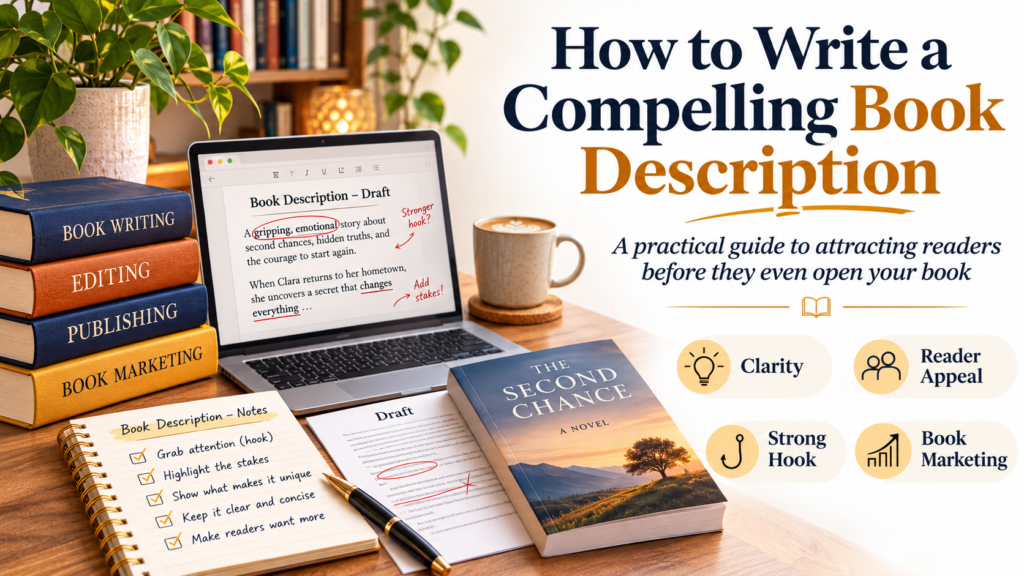
Writing a book can take months or even years.
Writing the description that sells it may take only a few paragraphs—but those paragraphs can have a major influence on whether someone decides to look closer.
Your book description is often one of the first things a potential reader sees after the title and cover. It appears on online bookstores, publishing platforms, retailer pages and promotional material.
That means it has an important job:
It must make the reader want to know more without telling them everything.
Start With a Strong Hook
The opening lines matter most.
Readers often scan rather than carefully read a book description, especially when comparing several books online.
Your first sentence should therefore create immediate interest.
For fiction, this might introduce the central conflict, unusual situation or emotional stakes.
For nonfiction, it might identify a problem, challenge or desirable outcome.
For example, instead of beginning with:
“This book is about cybersecurity for beginners.”
you might write:
“Cyber threats are becoming more sophisticated—but protecting yourself online does not need to be complicated.”
The second version gives the reader a reason to continue.
Write for the Reader, Not the Author
Authors naturally want to explain everything they have included in the book.
That is rarely the best approach.
A description should focus on what matters to the person considering whether to read it.
Ask:
- What problem does this book solve?
- What will the reader learn?
- What emotions will the story create?
- Why is this book relevant to them?
- What makes it different?
For nonfiction, communicate benefits rather than simply listing chapters.
Instead of saying:
“Chapter 3 discusses career planning.”
you might say:
“Learn how to identify the career direction that best matches your strengths and long-term goals.”
The reader cares more about the outcome than the chapter number.
Create Curiosity Without Giving Everything Away
For fiction, your description should reveal enough of the plot to establish the characters, setting and conflict—but stop before resolving the story.
Think of it as a movie trailer.
You want the reader to understand what is at stake while still wondering:
What happens next?
Avoid summarizing the entire novel.
For nonfiction, curiosity works differently. You might highlight the problem and promise useful insight without explaining every recommendation in the description itself.
The objective is to create enough value that the reader wants the complete book.
Show What Makes the Book Different
There may already be hundreds of books about your subject.
Why should someone choose yours?
Your description should communicate the book’s distinctive angle.
Perhaps the book is:
- Written specifically for beginners
- Based on professional experience
- Focused on practical steps
- Designed for parents
- Written for career changers
- Built around real-world examples
- Focused on a particular industry or audience
Do not rely on vague statements such as:
“This is the ultimate guide.”
Explain what actually makes it useful.
Specificity creates more credibility than exaggerated claims.
Keep the Description Clear and Easy to Scan
Online readers have limited attention.
Large blocks of text can make even an excellent description difficult to read.
Use short paragraphs and clear language.
For nonfiction, a short list can work well when it communicates specific benefits.
For example:
Inside this book, you will learn how to:
- Understand the fundamentals of cybersecurity
- Recognize common online threats
- Protect accounts and personal information
- Build safer digital habits
This makes the value immediately visible.
Include Relevant Keywords Naturally
A book description can also support discoverability.
If your book focuses on cybersecurity careers, self-publishing, leadership, personal finance or another clearly defined subject, relevant terminology should appear naturally in the description.
But do not force keywords into every sentence.
A description written primarily for search engines can become awkward and unconvincing for actual readers.
The best approach is simple:
Write for people first, then make sure important search terms appear naturally where they genuinely describe the book.
Match the Tone of the Book
Your description should feel like the book it represents.
A serious business book should not sound like a fantasy novel.
A children’s book should not have the tone of an academic publication.
A thriller may benefit from urgency and tension, while a professional nonfiction book may need clarity and authority.
Consistency creates the right expectation before the reader even opens the first page.
End With a Reason to Read
The final line should encourage the reader to take the next step.
For nonfiction, you might reinforce the transformation or benefit.
For fiction, end with tension, possibility or an unanswered question.
Avoid aggressive sales language.
The goal is not to pressure the reader.
It is to make the decision feel natural.
Your Book Description Is Part of Your Publishing Strategy
A strong manuscript deserves a strong presentation.
At DevOM Publishing, the publishing journey extends beyond writing and editing. Book positioning, cover design, formatting, metadata, distribution and marketing all influence how readers discover and evaluate a book.
Your description is part of that experience.
It should explain enough to create confidence, reveal enough to generate curiosity and remain focused enough to be remembered.
A good book description does not tell readers everything.
It gives them just enough reason to open the book and discover the rest.
To know more about Anand Shinde and his work in cybersecurity, awareness, and books:
https://anandshinde.com/
If your business needs cybersecurity services, AI security guidance, cloud security review, or protection against modern cyber threats, visit DevOM Consulting:
https://devomconsulting.com/