A strong book title can catch a reader’s attention.
A strong subtitle can convince them that the book is actually for them.
Authors often spend weeks debating the perfect main title but treat the subtitle as an afterthought. For many nonfiction books in particular, that is a missed opportunity.
Your subtitle can explain what the title alone cannot. It can clarify the subject, identify the intended reader, communicate the book’s promise and make the publication easier to understand when someone discovers it online.
The objective is not to squeeze every possible keyword underneath your title.
It is to answer one simple reader question:
“What exactly will this book give me?”
Understand the Different Jobs of the Title and Subtitle
Think of the main title as the part readers remember.
The subtitle is often the part that explains.
Imagine a career book called:
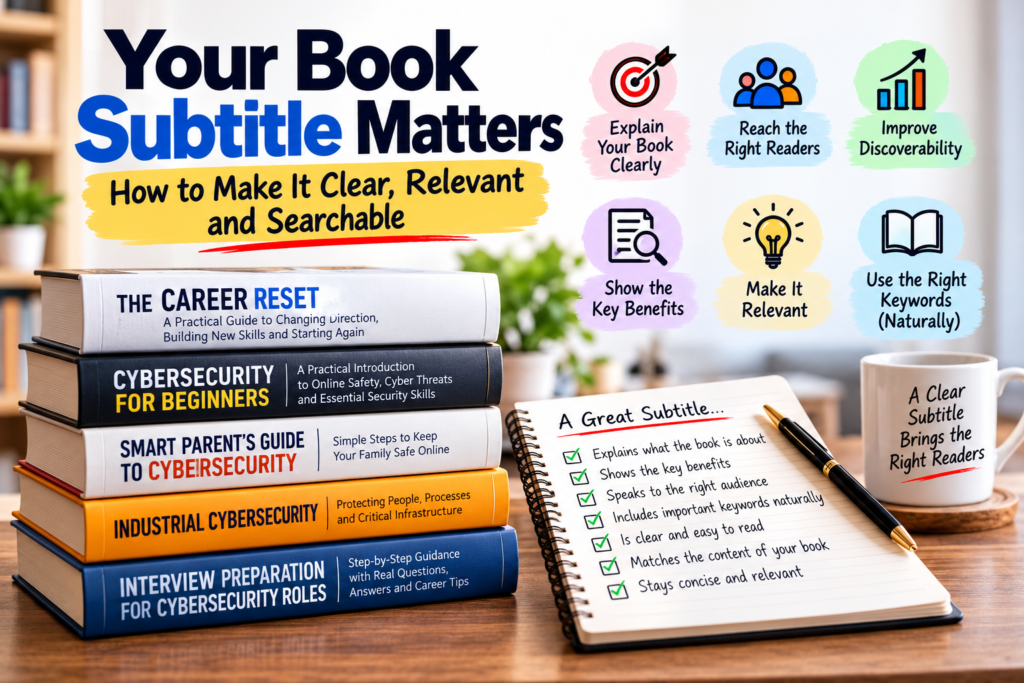
The Career Reset
It sounds interesting, but it leaves several questions unanswered.
Now consider:
The Career Reset: A Practical Guide to Changing Direction, Building New Skills and Starting Again
The main title creates identity.
The subtitle creates context.
Together, they tell the reader much more than either could do alone.
This is particularly useful for nonfiction, business, career, technology, self-development and educational books, where readers often want to understand the practical value before purchasing.
Make the Benefit Clear
A useful subtitle should communicate what the reader can expect.
Instead of describing only the subject, think about the outcome.
For example:
Cybersecurity for Beginners
is clear, but relatively broad.
A subtitle might make the promise more specific:
A Practical Introduction to Online Safety, Cyber Threats and Essential Security Skills
Now the reader understands both the level and the areas the book intends to cover.
Ask yourself:
What problem does the book help solve?
What will the reader understand afterwards?
What transformation or knowledge does it offer?
The clearer those answers are, the easier it becomes to create a meaningful subtitle.
Write for Your Target Reader
A subtitle should speak to the audience you actually want to reach.
Consider the difference between:
A Guide to Personal Finance
and:
A Simple Money Management Guide for Young Professionals Starting Their Careers
The second is much more targeted.
That does not automatically make it a better subtitle for every book. But if young professionals are genuinely the intended audience, the additional clarity can help the right reader recognize that immediately.
Avoid trying to appeal to everybody.
A subtitle that speaks clearly to the correct audience is usually more useful than one broad enough to mean almost anything.
Think About Searchability—Naturally
Book discoverability matters.
Readers increasingly find books through Amazon, Google, online bookstores and recommendation platforms. The words used in your title, subtitle, description, categories and metadata can help platforms understand what your book is about.
This does not mean turning your subtitle into a string of search terms.
Amazon KDP specifically warns against repetitive generic keywords and misleading metadata. Its keyword guidance recommends thinking like a reader and using accurate search terms in the dedicated keyword fields rather than overloading titles with unnecessary phrases.
If an important search phrase fits naturally into your subtitle and accurately describes the book, use it.
If it makes the subtitle awkward, leave it for the book description and keyword metadata.
Clarity comes before keyword density.
Avoid Making the Subtitle Too Long
Authors sometimes try to make the subtitle explain the entire book.
That usually produces something difficult to read, remember and display on a cover.
Amazon currently requires the combined title and subtitle to remain below 200 characters. It also notes that customers may skim past excessively long titles.
The practical lesson is not to aim for 199 characters.
It is to remove anything that does not improve understanding.
Read your subtitle aloud.
If you struggle to finish it comfortably in one breath, it may be trying to do too much.
Make Sure the Subtitle Matches the Book
Never promise something the manuscript does not deliver.
A subtitle such as:
The Complete Guide to Building a Cybersecurity Career
creates a significant expectation.
If the book covers only interview preparation, the subtitle is misleading.
Your subtitle is part of the promise you make to the reader.
Accuracy matters for trust, reviews and long-term author credibility.
It also matters technically. On Amazon KDP, the subtitle entered in your book metadata should correspond with the subtitle used on the published book.
Test Several Versions Before Publishing
Do not stop at the first subtitle that sounds acceptable.
Create multiple variations.
Try one focused on the reader.
Try one focused on the outcome.
Try one that emphasizes the problem.
Try another that explains the method or subject.
Then ask potential readers what they think the book is about after seeing only the title and subtitle.
If their answer matches your intention, the subtitle is doing its job.
Your Subtitle Is Part of Your Publishing Strategy
A subtitle may consist of only a few words, but those words influence the cover, metadata, online listing, marketing and first impression of the book.
At DevOM Publishing, title and subtitle decisions should therefore be considered alongside manuscript development, editing, cover design, formatting, metadata preparation and distribution.
A strong subtitle does not need to sound complicated.
It needs to be clear, relevant and honest about what the reader will receive.
Your title may make someone stop.
Your subtitle should give them a reason to look closer.
And when both work together, your book becomes easier to understand, easier to position and easier for the right reader to discover.
To know more about Anand Shinde and his work in cybersecurity, awareness, and books:
https://anandshinde.com/
If your business needs cybersecurity services, AI security guidance, cloud security review, or protection against modern cyber threats, visit DevOM Consulting:
https://devomconsulting.com/