
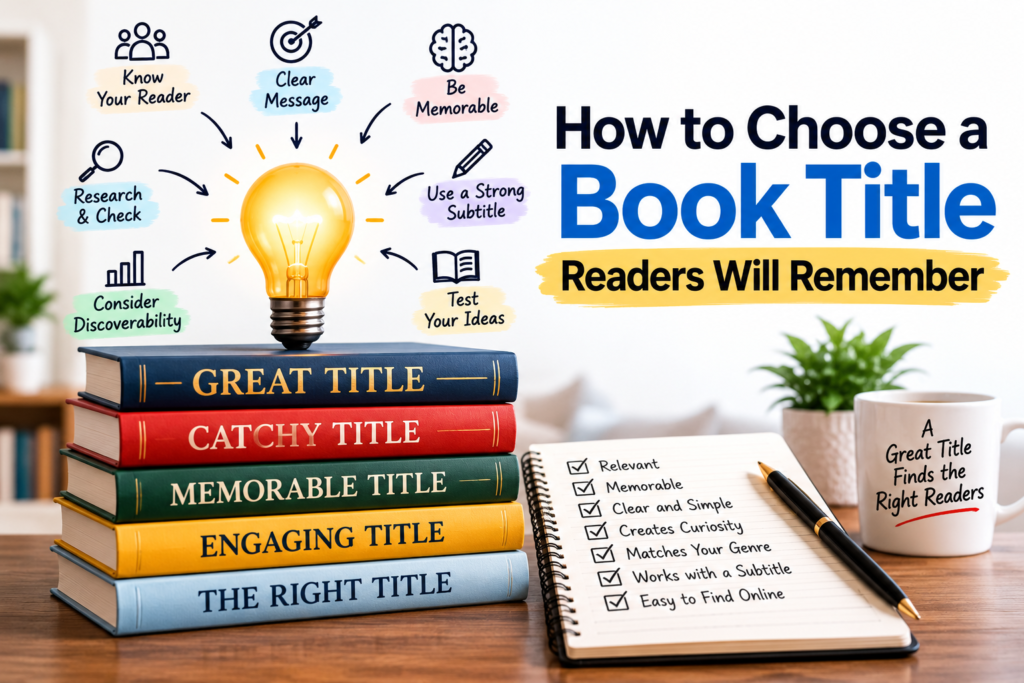
You may spend months—or even years—writing a book, but readers may spend only a few seconds deciding whether its title deserves their attention.
That makes your book title one of the smallest yet most important pieces of the publishing process.
A strong title should be memorable, relevant and easy to understand. It should create curiosity without confusing the reader and communicate enough about the book to attract the right audience.
So how do you choose a title that works?
The process begins by understanding what you want the title to achieve.
Start With the Promise of Your Book
Before brainstorming clever phrases, ask a more fundamental question:
What is this book really offering the reader?
For nonfiction, the answer may be knowledge, transformation, guidance or a solution to a specific problem.
For fiction, it may be an experience, mystery, emotion, character journey or world readers want to enter.
Your title does not need to explain the complete book, but it should feel connected to its central idea.
If someone reads the title and then finishes the book, the title should make even more sense—not less.
Make It Easy to Remember
A memorable title is usually easier to say, spell and recall.
Long or unnecessarily complicated titles can make word-of-mouth recommendations harder. Imagine a reader telling a friend about your book.
Can they remember its name?
Can they type it into a search bar later?
Can they pronounce it confidently?
Simple does not mean boring. Some powerful titles are memorable precisely because they communicate one strong idea rather than attempting to explain everything.
Amazon KDP itself advises authors to think carefully about title length and notes that customers may skim past overly long titles.
Create Curiosity Without Creating Confusion
A good title should give the reader a reason to look closer.
For fiction, curiosity might come from an unusual phrase, a character, a place or an intriguing contradiction.
For nonfiction, the title may identify a problem, desirable outcome or distinctive concept.
But mystery has limits.
If a title is so abstract that readers cannot tell what kind of book they are looking at, curiosity can quickly become uncertainty.
The strongest titles often reveal enough to attract the right audience while leaving enough unanswered to encourage the reader to explore the cover, subtitle and description.
Use the Subtitle Strategically
A subtitle can give you freedom to keep the main title memorable while using the secondary line to explain the book.
Imagine a nonfiction book called:
The Career Reset
That title is short and memorable, but it does not fully explain the book.
A subtitle could add clarity:
The Career Reset: A Practical Guide to Changing Direction, Building New Skills and Starting Again
The title creates identity.
The subtitle explains the promise.
This approach can be especially useful for professional, educational and business books.
Amazon KDP treats the subtitle as additional information about the book and requires the published title and subtitle metadata to correspond with the actual book.
Think Like Your Reader
Authors naturally become emotionally attached to titles that have personal meaning.
But readers encounter the book without the background knowledge the author possesses.
Test your potential title from their perspective.
Would your target reader understand its relevance?
Does it sound appropriate for the genre?
Would someone interested in the subject want to know more?
Does it resemble the type of book they expected to find—or does it unintentionally suggest another genre?
A title for a cybersecurity handbook should create a very different expectation from a psychological thriller.
Understanding your target reader helps you make that distinction.
Do Not Turn the Title Into a Keyword List
Discoverability matters, particularly for nonfiction books, but that does not mean every possible search term belongs in the title.
Titles overloaded with keywords often become awkward, difficult to remember and less professional.
Amazon specifically prohibits manipulating book-title metadata with repetitive generic keywords and recommends using separate keyword fields to help readers discover books.
A better approach is to create a natural title and subtitle, then support discoverability through accurate metadata, categories, descriptions and relevant publishing keywords.
Write the title for the reader first. Optimize the surrounding metadata for discovery.
Research Before You Commit
Before finalizing a book title, search for it.
Check major bookstores, search engines, publishing platforms and library catalogues.
You may discover that the title already belongs to a well-known book, is strongly associated with another author, creates confusion with an established brand or is extremely difficult to distinguish online.
A similar title does not automatically mean you cannot use it, but you should understand the competitive landscape before investing in cover design, ISBN registration and marketing.
The earlier you identify a problem, the easier it is to change direction.
Test Several Titles, Not Just One
Your first title idea may be excellent.
It may also simply be the first idea you had.
Create alternatives.
Try short titles, descriptive titles, emotional titles, question-based titles and combinations of title plus subtitle.
Then ask beta readers, potential readers, editors or trusted people within your target audience what they remember after seeing the options.
Do not ask only:
“Which title do you like?”
Ask:
“Which title would you remember tomorrow?”
That question reveals something much more valuable.
The Title Is Part of Your Book’s Identity
A good book title cannot rescue a weak manuscript.
But a poor title can make a strong manuscript unnecessarily difficult to discover, remember and recommend.
At DevOM Publishing, choosing the right title should be considered part of the broader publishing journey alongside manuscript development, editing, cover design, formatting, metadata preparation and distribution.
The goal is not simply to create something clever.
It is to find a title that reflects the book, attracts the right reader and continues to feel right long after publication.
Because before someone reads your first chapter, your introduction or even your back-cover description, they usually encounter something much shorter:
your title.
Make those words count.
To know more about Anand Shinde and his work in cybersecurity, awareness, and books:
https://anandshinde.com/
If your business needs cybersecurity services, AI security guidance, cloud security review, or protection against modern cyber threats, visit DevOM Consulting:
https://devomconsulting.com/