
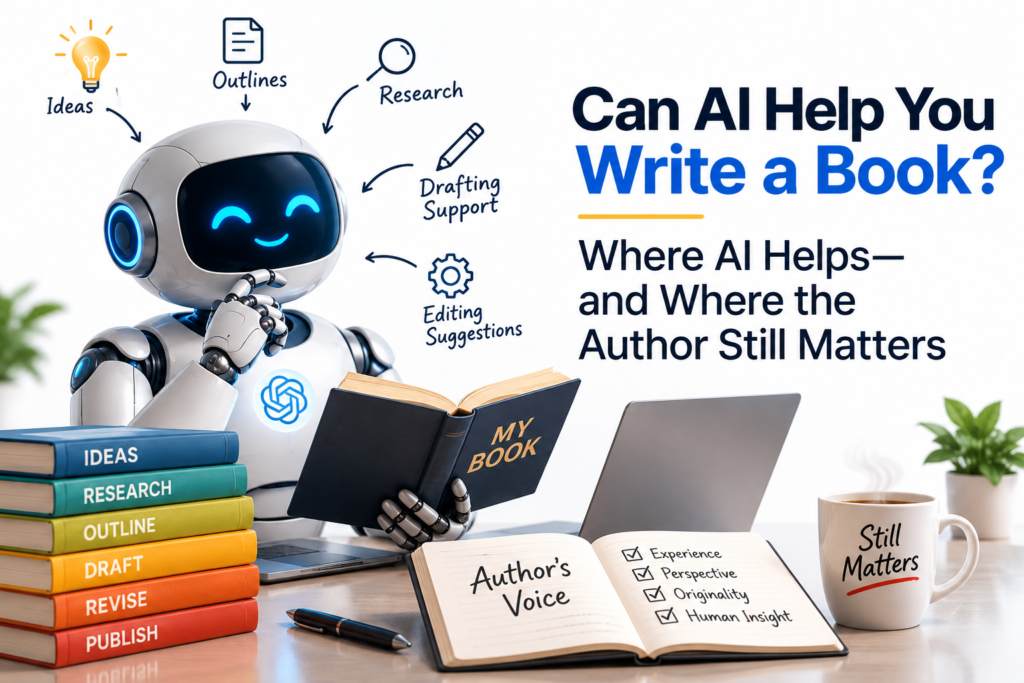
Artificial intelligence can generate an outline in seconds, suggest chapter titles, rewrite a paragraph and even produce pages of text from a simple prompt.
So it is understandable that aspiring authors are asking:
Can AI help me write my book?
The answer is yes—but there is an important difference between using AI as a writing assistant and allowing AI to become the author.
Used thoughtfully, AI can make parts of the book-writing process faster and more organized. But the experiences, ideas, judgment, originality and voice that make a book worth reading still need to come from the author.
AI Can Help You Develop an Idea
Many books begin with an idea that is still too broad.
An author may know they want to write about cybersecurity, leadership, parenting, career development or a personal journey but struggle to decide how to structure the subject.
AI can help brainstorm possible angles, reader questions and chapter themes.
For example, an author can ask AI to identify questions a beginner might have about a topic or suggest several ways of organizing a nonfiction book.
The useful part is not accepting the first outline AI produces.
It is using those suggestions to stimulate your own thinking.
AI Can Support Research—but It Cannot Replace Verification
AI can also help authors explore terminology, summarize concepts or identify areas that deserve further research.
That can make early research faster.
However, AI systems can provide inaccurate information, outdated material or references that do not exist. Authors should therefore verify important facts using reliable original sources.
This becomes especially important when writing about history, medicine, finance, law, cybersecurity or other subjects where incorrect information can seriously damage a book’s credibility.
AI can help you investigate. The author remains responsible for accuracy.
AI Can Be Useful During Revision
One of the most practical uses of AI comes after the author has already written the material.
AI tools can help identify repetitive sentences, suggest clearer wording, highlight awkward passages or provide alternative ways to express an idea.
They can also support grammar and spelling checks.
Amazon KDP currently distinguishes between AI-generated content and AI-assisted content. Content created by the author and then refined or checked using AI is considered AI-assisted, while actual text or images produced by an AI tool are treated as AI-generated content for KDP disclosure purposes.
That distinction illustrates an increasingly important question in publishing:
Who actually created the book?
What AI Cannot Give Your Book
AI can generate grammatically correct sentences.
What it cannot genuinely possess is your life.
It did not experience your career, build your business, raise your family, make your mistakes, visit the places you describe or spend years developing your professional expertise.
Those experiences create perspective.
And perspective is often what separates a memorable book from information that could have been found anywhere online.
Readers do not simply need more words. They need a reason to read your words.
Your stories, opinions, observations, examples and conclusions create that reason.
Your Voice Still Matters
Books also develop a relationship between author and reader.
A strong authorial voice allows readers to recognize how you think and what you care about.
If every paragraph is generated independently by AI, that voice can easily become generic. The writing may sound polished while saying very little that is distinctive.
Professional editing should strengthen an author’s voice—not replace it.
AI should ideally serve the same purpose.
Human Authorship Also Matters Legally
The distinction between human and AI creation is becoming important beyond writing quality.
The U.S. Copyright Office has stated that generative-AI output can receive copyright protection only where sufficient expressive elements are determined by a human author. Simply providing prompts is not, by itself, enough to establish human authorship. AI-assisted creation, however, does not automatically prevent copyright protection for the human-authored elements of a work.
Authors should therefore understand both publishing-platform requirements and applicable copyright rules when using generative AI.
Think of AI as an Assistant, Not Your Replacement
The most productive question may not be:
“Can AI write my book?”
Instead ask:
“Where can AI remove unnecessary friction while I remain responsible for the book?”
AI can help brainstorm.
AI can organize ideas.
AI can support research.
AI can identify language that needs improvement.
AI can help you work more efficiently.
But the author should still determine what the book believes, what it says and why it deserves to exist.
At DevOM Publishing, technology can support the publishing journey, but the author’s ideas and identity remain at its centre. Professional editing, proofreading, formatting, cover design and publishing services should help transform an author’s manuscript into a professional book without losing what makes that manuscript personal.
The future of publishing will almost certainly include more AI.
But great books will still need something technology cannot manufacture on demand:
a human being with something meaningful to say.
To know more about Anand Shinde and his work in cybersecurity, awareness, and books:
https://anandshinde.com/
If your business needs cybersecurity services, AI security guidance, cloud security review, or protection against modern cyber threats, visit DevOM Consulting:
https://devomconsulting.com/