
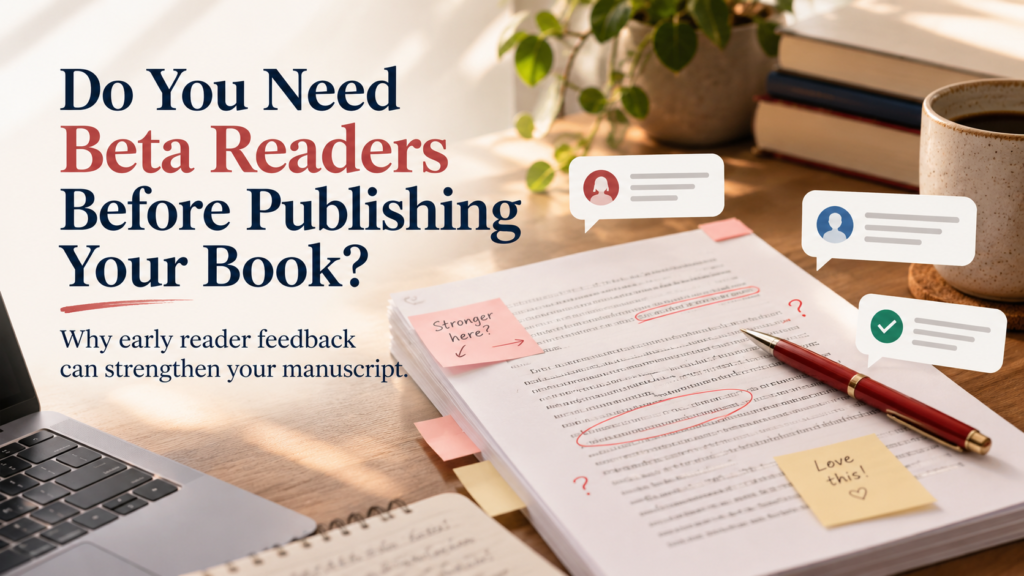
You have finished your manuscript, revised it several times and reached the point where you are beginning to think about editing, formatting, cover design and publication.
Then another question appears:
Should I give my book to beta readers before publishing it?
For many authors, the answer is yes—but only if beta readers are used at the right stage and for the right purpose.
Beta readers can provide valuable feedback from the perspective that ultimately matters most: the reader. However, they are not a replacement for professional editing, proofreading or publishing preparation.
Understanding the difference can make the feedback far more useful.
What Is a Beta Reader?
A beta reader reads a manuscript before publication and provides feedback based on the reading experience.
Unlike a professional editor, a beta reader usually approaches the manuscript primarily as a member of the target audience.
They may comment on questions such as:
- Was the book engaging?
- Were any chapters confusing?
- Did the story become slow at certain points?
- Were the characters believable?
- Did anything feel repetitive?
- Were important questions left unanswered?
- Was the language appropriate for the intended audience?
For nonfiction, beta readers can also identify areas where explanations are unclear, examples are insufficient or assumptions are made about what the reader already knows.
Their job is not necessarily to correct every grammatical error. Their value lies in telling you how the book feels to a real reader.
When Should You Use Beta Readers?
Beta readers are most useful after you have completed a solid draft and performed your own revisions, but before the manuscript reaches its final editorial stages.
Do not send your very first draft simply because you want feedback quickly.
If you already know that chapters are incomplete, the structure is changing or sections need major rewriting, fix those obvious issues first.
Your beta readers should be responding to a manuscript that represents your best current version.
After receiving feedback, you can decide what revisions make sense before moving into professional editing.
A common sequence might look like this:
Manuscript Draft → Author Revision → Beta Reading → Further Revision → Professional Editing → Formatting → Proofreading → Publication
The exact workflow can vary depending on the book, but the important point is that beta reading and professional editing serve different purposes.
Beta Readers vs Professional Editors
This distinction is critical.
A beta reader might say:
“I lost interest in the middle of Chapter 5.”
A developmental editor may help identify why that happened and suggest structural changes.
A beta reader might say:
“This explanation was difficult to understand.”
A copy editor may then improve clarity, sentence structure, consistency and readability.
A beta reader may notice a typo, but proofreading is still required to systematically identify errors before publication.
In simple terms:
Beta readers tell you how the book is experienced. Professional editors help improve how the book is constructed and written.
Both can be valuable, but they should not be confused.
How Many Beta Readers Do You Need?
There is no universal number.
For many authors, around three to six thoughtful beta readers can provide a useful range of perspectives without creating an overwhelming amount of conflicting feedback.
Quality matters more than quantity.
Ideally, at least some beta readers should resemble your intended audience.
If you are writing a beginner’s guide to cybersecurity, for example, feedback only from experienced cybersecurity professionals may not reveal whether a beginner can actually understand the material.
Similarly, if you are writing a novel for young adults, feedback from readers in or familiar with that audience can be particularly useful.
Do You Have to Accept Every Comment?
No.
One of the hardest parts of working with beta readers is learning how to interpret feedback rather than reacting to every individual opinion.
If one reader dislikes a particular chapter while five others find it effective, you may decide no major change is needed.
If several readers independently identify the same confusing section, however, that is worth investigating.
Look for patterns, not instructions.
The author remains responsible for the final creative decisions.
What Should You Ask Beta Readers?
Do not simply ask, “Did you like my book?”
Give beta readers useful questions.
Ask where they became most engaged, where they lost interest, what confused them, which sections felt unnecessary and what they expected but did not receive.
For fiction, ask about characters, pacing, dialogue and emotional impact.
For nonfiction, ask whether concepts were clearly explained, whether examples were useful and whether the reader felt they received what the book promised.
Specific questions produce more useful feedback.
Are Beta Readers Necessary for Every Book?
Not necessarily.
Some manuscripts already go through substantial feedback from editors, subject-matter experts or writing groups. Other authors may be working under tight publishing timelines.
But when used properly, beta readers provide something difficult for an author to recreate alone: fresh eyes.
After months or years working on a manuscript, you know what every paragraph is supposed to mean. A new reader only sees what is actually on the page.
That perspective can be extremely valuable.
From Reader Feedback to a Publication-Ready Book
Beta readers can help strengthen your manuscript, but they are one step in a larger publishing journey.
At DevOM Publishing, we believe authors benefit most when each stage has a clear purpose—from manuscript assessment and editing to proofreading, formatting, cover design, metadata and distribution.
Beta readers can help you understand how real readers respond to your book.
Professional publishing services help turn those insights into a polished final product.
Before publishing, ask yourself:
Has anyone outside my own writing process experienced this book as a reader?
If the answer is no, a small group of carefully selected beta readers may give you exactly the perspective your manuscript needs before it moves toward publication.
To know more about Anand Shinde and his work in cybersecurity, awareness, and books:
https://anandshinde.com/
If your business needs cybersecurity services, AI security guidance, cloud security review, or protection against modern cyber threats, visit DevOM Consulting:
https://devomconsulting.com/